Decarbonizing the Built Environment Through Heritage (DBTH) Policy Brief
A framework for policymakers to advance climate change mitigation through heritage-informed solutions.
Climate solutions for the built environment already exist in heritage places and practices around the world. Heritage-informed decarbonization draws on time-tested knowledge and the existing building stock as resources to reduce emissions while centering people and communities in climate action.
Adapted from the Decarbonizing the Built Environment Through Heritage (DBTH) Toolkit, this Policy Brief helps decision makers integrate heritage-informed decarbonization into climate, building, land-use, and heritage policy. It provides five principles, practical policy levers, real-world examples, and points of entry for implementing solutions within local contexts.
A framework for policy action
The Policy Brief demonstrates how policymakers can:
Use existing and heritage buildings as decarbonization assets
Advance multiple public priorities at once, linking decarbonization with housing, health, jobs, resilience, and resource conservation
Apply heritage knowledge to new development, drawing on proven, place-based approaches to building and adaptation
Put these approaches into practice through five principles, policy levers, real-world examples, and points of entry
Five Principles of Heritage-Informed Decarbonization
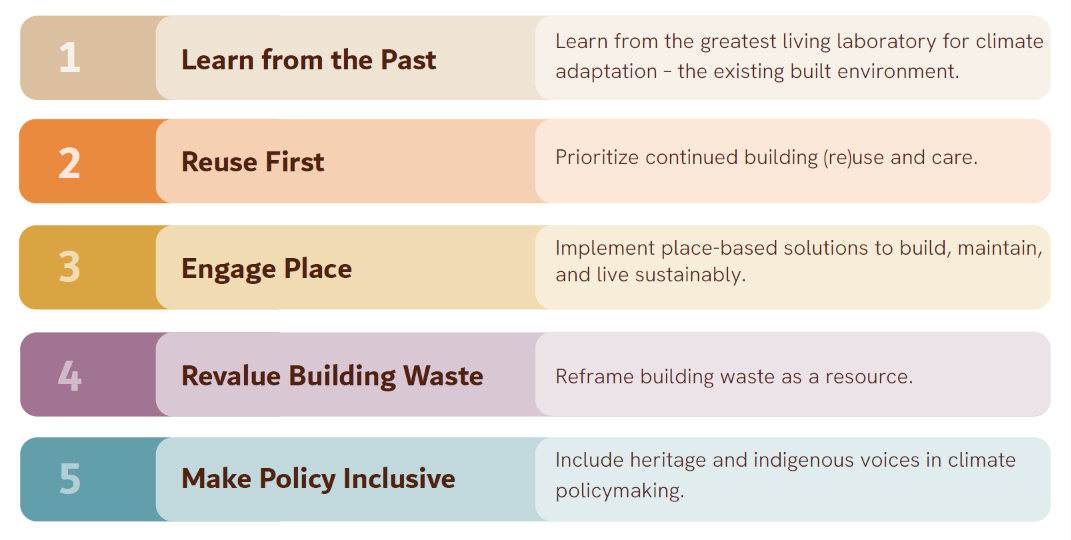
Scaling heritage solutions
Climate solutions for the built environment already exist in the heritage places and practices of many communities. The policy challenge is to recognize, enable, adapt, and scale these solutions as viable decarbonization strategies.
Governments can advance these approaches through regulation, economic incentives, public investment, informational tools, property-based mechanisms, and stronger coordination across climate, building, land-use, and heritage policies. Some contexts require new policies or policymaking processes; others can move forward through targeted changes to existing approaches.
[Download the Policy Brief]
Explore the Complete DBTH Toolkit
meet the team
-

Lori Ferriss, Built Buildings Lab
PROJECT LEAD
-

Elizabeth Rowe, Built Buildings Lab
POLICY LEAD
-

Billie Faircloth, Built Buildings Lab
RESEARCH LEAD
-

Mokọ́ládé B Johnson, University of Lagos
AFRICA REGION LEAD